
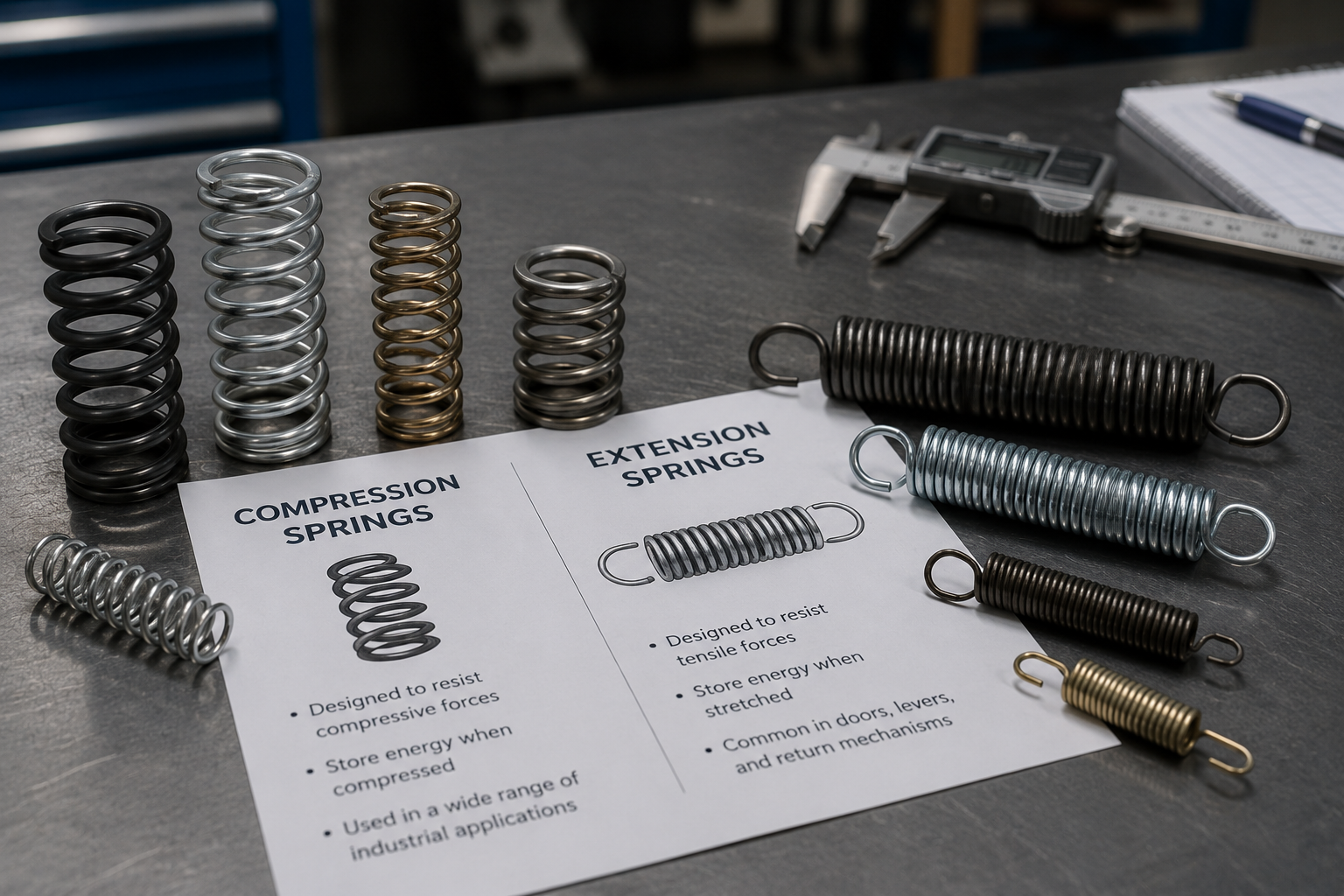
Compression vs. Extension Springs: Key Differences, Applications, and When to Use Each
Quick Answer: Compression springs resist being pushed together (they push back); extension springs resist being pulled apart (they pull back). Compression springs are simpler and cheaper; extension springs fit tighter spaces. Choose based on your load direction and space constraints.
Why Spring Type Matters
Choosing between compression and extension springs affects not just functionality but also cost, reliability, and design complexity. The wrong spring type for your application means inefficient force transfer, premature failure, or wasted space.
This decision happens early in mechanical design. Before you commit to a layout, you need to understand the tradeoffs between these two fundamental spring types.
Compression Springs: The Basics
Compression springs are coiled springs that resist being pushed together. When you compress them, they push back with a restoring force proportional to deflection. The more you compress, the harder they push back.
How they work: Compression springs operate in their natural state (relaxed) and work when compressed. When compressed, coil-to-coil contact becomes important — the coils must nest properly without binding. This limits how much you can compress before the spring becomes solid.
Advantages:
- Simpler design and manufacturing
- Lower cost than equivalent extension springs
- Better for high-cycle applications
- Easier to install and adjust
- More forgiving of some installation errors
Disadvantages:
- Require more physical space (they’re longest when unloaded)
- Cannot pull — they only push
- Coil-to-coil contact can cause issues if over-compressed
Common applications:
- Automotive suspension (wheel support)
- Machinery shock absorbers (impact resistance)
- Door closers (push-to-close force)
- Keyboard switches (key reset)
- Industrial press machines (work surface return)
Extension Springs: The Basics
Extension springs are coiled springs that resist being pulled apart. They start in tension (pre-tensioned) and stretch when you pull them. They pull back toward their original length.
How they work: Extension springs have hooks or loops at the ends for attaching to mounting points. Pre-tension in the coils means they resist being pulled even slightly. This internal tension affects their load curve differently than compression springs.
Advantages:
- Compact when loaded (shorter overall envelope)
- Can generate force without physical space for deflection
- Good for pulling applications (doors, gates, returns)
- Fit into tight spaces more easily
Disadvantages:
- More complex manufacturing (hooks/loops required)
- More expensive than equivalent compression springs
- Pre-tension must be precise or performance suffers
- Hook design affects stress concentration and fatigue life
- Cannot push — they only pull
Common applications:
- Screen door closers (pull-to-close)
- Garage door counterbalance (tension support)
- Machine clutches (engagement/disengagement)
- Suspension systems requiring tension (certain designs)
- Equipment safety stops (prevent opening)
Compression vs. Extension: Direct Comparison
| Factor | Compression | Extension |
|---|---|---|
| Force direction | Push (resists compression) | Pull (resists extension) |
| Space when loaded | Shorter | Longer |
| Space when unloaded | Longer | Shorter |
| Cost | Lower | Higher (3-5x more) |
| Manufacturing complexity | Simple coiling | Coiling + hook formation |
| Installation | Simple (just mount and compress) | Requires precise attachment points |
| Pre-tension | None (relaxed state) | Pre-tensioned internally |
| Max deflection | Limited by coil contact | Limited by hook design |
| Common mistake | Over-compression (going solid) | Incorrect pre-tension |
Choosing the Right Spring Type
Use compression springs when:
- You need to resist pushing/compression force
- Space below the spring is available for compression
- Cost is a primary concern
- You’re replacing a known design
- High cycle count is required (automotive, machinery)
Use extension springs when:
- You need to resist pulling force
- Space is extremely limited (compact design)
- You can’t use compression (no room below the load point)
- The aesthetic appeal matters (less visible coils)
- You’re pulling equipment or doors
Ask these questions:
- Which direction is the primary load? (Push = compression; Pull = extension)
- How much space do I have for spring deflection? (Limited space = extension)
- What’s my cost target? (Low cost = compression)
- How many cycles per year? (High cycle = verify fatigue rating)
- Is this a standard application or custom? (Standard = check existing designs)
Real-World Example: Automation Equipment
A client was designing an industrial packaging line that needed spring-driven platens (work surfaces) to reset after each cycle. The design engineer had space constraints and chose extension springs for compactness.
The problem: Extension springs are sensitive to installation errors. If the attachment hooks weren’t perfectly aligned, they’d twist under load, causing premature failure.
We redesigned using compression springs, adding a vertical guide rod that controlled the motion. This eliminated the hook alignment problem, reduced cost by 40%, and improved reliability. The only tradeoff was slightly taller overall height — but the machine layout accommodated it.
The lesson: Compression springs are more forgiving. Unless you have a compelling reason to use extension springs (severe space constraints, pulling application), compression springs usually win on cost, reliability, and simplicity.
Frequently Asked Questions
Q: Can I use a compression spring where an extension spring was designed? A: Rarely. If the design requires pulling force, a compression spring can’t provide it. However, you can often redesign the mechanism to use compression (add a guide rod, change attachment points). Talk to an engineer before changing spring types.
Q: Why are extension springs so much more expensive? A: Extension springs require coiling plus hook formation (adds manufacturing steps). Pre-tensioning is precisely controlled (additional QC). The result is 3-5x the cost of an equivalent compression spring. Cost increases further with specialty materials or hooks.
Q: What does “pre-tension” mean in extension springs? A: Pre-tension is internal stress in the coils that makes the spring resist even small pulling forces. When you hang an extension spring, it resists stretching slightly before it starts deflecting measurably. This affects the load curve and must be precisely controlled.
Q: How much can I compress a compression spring? A: A compression spring can be compressed until the coils touch (solid length). Compressing beyond this damages the spring. Well-designed applications never compress to solid — they stay well within safe deflection limits.
Q: Why do extension spring hooks fail? A: Extension spring hooks are stress concentration points. The sharp corners where wire curves into a hook create high stress. Under high cycle counts or misalignment, cracks start at these corners. This is why material selection and hook design are critical for extension springs.
Q: Can I change the hooks on an extension spring? A: Not really. The hooks are part of the manufacturing process. Attempting to modify them introduces damage and stress concentration. If the hooks don’t work, you need a redesigned spring — not a modification.
Q: Do compression and extension springs have different cycle life? A: Not inherently, but their failure modes differ. Compression springs typically fail from coil-to-coil fretting (friction between coils). Extension springs fail at hook stress concentration. Both can be engineered for high cycle life with proper design and material selection.
Ready to Select Your Spring Type?
The right spring type makes the difference between efficient, reliable equipment and troublesome designs that require constant adjustment. Our engineering team can evaluate your application, space constraints, and load requirements to recommend the optimal spring type.
Contact us for a free spring type consultation. We’ll help you choose compression or extension springs based on your specific mechanical needs — and show you the cost and performance differences.
- Explore our compression springs designs and extension springs applications.
- Learn more about custom spring design capabilities
- Explore related: How Spring Materials Affect Performance
- See our torsion springs and barrel springs for other spring types.
Ready to Find Your Spring Solution?
Contact Minuteman Springs for same-day quoting on custom compression springs, extension springs, torsion springs, and more.
Minuteman Spring Co., Inc.
Ready to discuss your spring requirements?
Same-day quoting, full engineering support, and precision manufacturing from prototype through production. Founded in 1946. Millbury, Massachusetts.
Request a Quote